Snip a young plant’s root, and it regrows its tip as if it remembers its shape. A new study from IISER-Pune shows this recovery relies on more than just genes or hormones.
SEP 03, 2025 | BY RATNESHWAR THAKUR
Cut off the tip of a young plant’s root, and something remarkable happens. Instead of stalling or growing awkwardly, the root steadily rebuilds its original tapered tip—almost as if it remembers its shape. A new study from Indian Institute of Science Education and Research (IISER-Pune) in Current Biology reveals that this recovery doesn’t rely only on genes or hormones. Instead, plants harness the physics of geometry and mechanical stress to put themselves back together.
While studying root-tip geometry, Mabel M. Mathew—then a PhD student at IISER-Pune and now a postdoctoral fellow at Stanford University — became fascinated by the elegant form of root tips. Roots naturally taper into a point, an adaptation that helps them push through soil. Mathew wondered: if that taper was cut away, could a plant rebuild it, and how would it know the correct shape?
That curiosity sparked a collaborative investigation between experimental biologists at IISER-Pune and computational modelers from India, the Netherlands, and the UK. The team combined live imaging, microsurgery, mathematical modelling, and cell biology to reveal a shape-rebuilding process in the root tips of Arabidopsis thaliana —a model plant widely used in plant research.
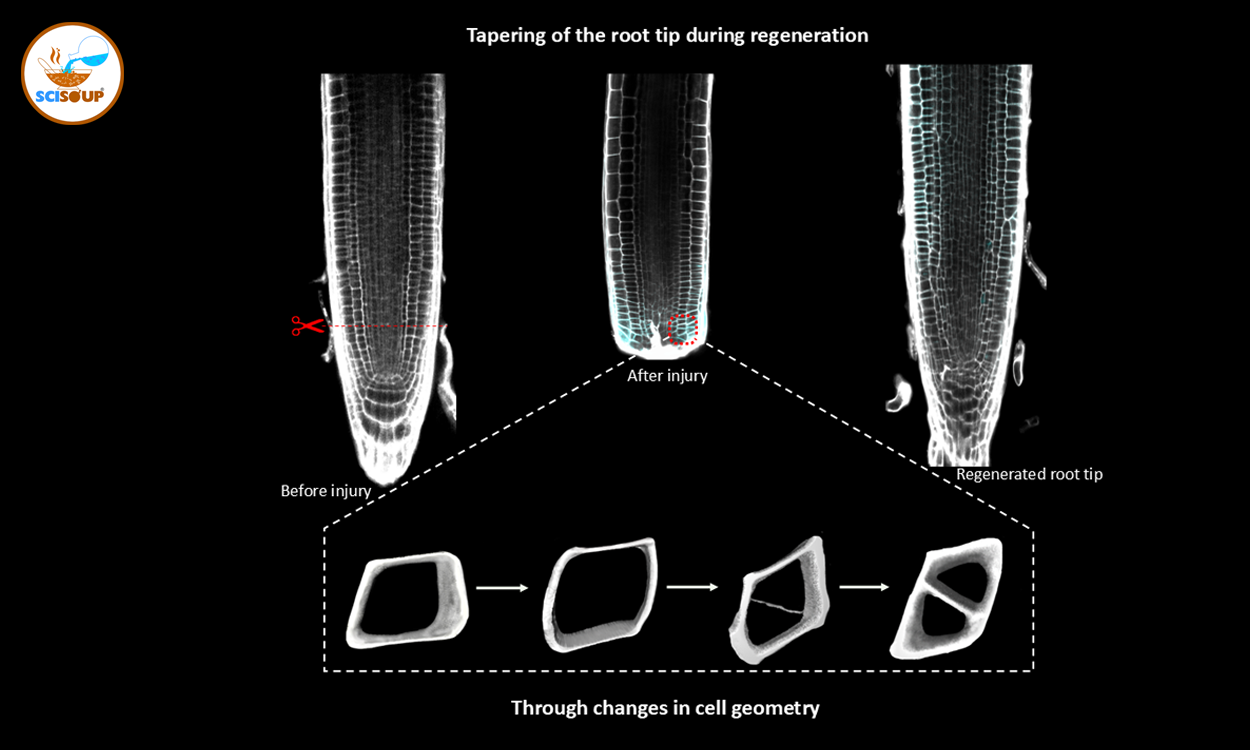
They found that roots regenerate their missing tips through a two-step process driven by mechanics. First, cells at the wound edge are pulled out of their usual cuboidal form into rhomboid shapes because of uneven growth stresses between neighbouring tissues. Then, these skewed cells divide diagonally, producing daughter cells shaped like triangular prisms. Those oddly shaped daughter cells redirect surrounding cells into slanted growth paths. Step by step, the once-blunt root cylinder reshapes itself into a taper and, finally, a rounded tip.
Inside the injured root, different tissue layers don’t all grow at the same rate. Inner cells expand more quickly than outer ones, creating tension that bends and skews cell walls. This physical strain reshapes cells and determines the angle of their divisions. The cell’s internal scaffold—the cytoskeleton—helps enforce these geometric rules. When researchers disrupted the cytoskeleton, roots failed to form rhomboid cells, and regeneration stalled.
The discovery is striking because it shows how living tissues can organize themselves using simple mechanical principles. While genes still set the stage, the actual rebuilding of shape depends on physical interactions.
The team’s turning point came when Mathew spotted something fleeting under the microscope: a once-ordinary cortical cell stretching into a rhomboid, then splitting diagonally. That observation was the missing link. It showed how geometry itself could act as the blueprint for regeneration.
The study shows that roots restore their shape by following two simple steps: growth conflicts create unusual cell shapes, and those shapes then guide new growth directions. This self-organizing process explains how a plant can rebuild a structure as precise as a tapered tip—without requiring a detailed genetic manual for every step.
The research team included Mabel Maria Mathew, Jeroen Saccheri, Srijan Das, Kreedika Rajagopalan, Brendan Lane, Sidhardh KA, Richard S. Smith, Viola Willemsen, Monica L. Garcia Gomez, Bandan Chakrabortty, Ben Scheres, Kirsten Ten Tusscher, and Kalika Prasad. .
Journal Reference:
Wound repair in plants guided by cell geometry
Disclaimer:
SciSoup claims no competing interest. To ensure accuracy and scientific relevance, this science blog has been reviewed by the research team involved in the study.